A brief history of hair transplantation
Hair transplantation has a surprisingly long past. The first medical text on the subject was published by Dr. Unger in Germany in 1822. Although showing that hair moved from one side of a patient's head to the other could survive hinted that baldness might become history, problems with anaesthesia and surgical technique held back its development until the 1930s.
The 19th century is recorded as an era when the lotions and essences of medical charlatans, drug peddlers claiming to grow hair, were in vogue. The graft technique still used today emerged with the work of Dr. Okuda in Japan in 1939 and Dr. Orentreich in America in 1959. As male-pattern baldness was understood to be genetic, hair physiology was better understood and micro-instruments were produced, Dr. Limmer described FUT (Follicular Unit Transplantation) in 1994 and Dr. Bernstein described FUE (Follicular Unit Extraction) in 2002. The principle of transplanting hair did not change, only the technology needed to transplant it as single follicles advanced.
The difference between FUT and FUE
In the FUT technique, a long horizontal strip of hair-bearing scalp is cut from the nape, the donor area is closed by bringing the edges together, and the follicles in the removed strip are divided by hand into small units and placed into channels opened at the front.
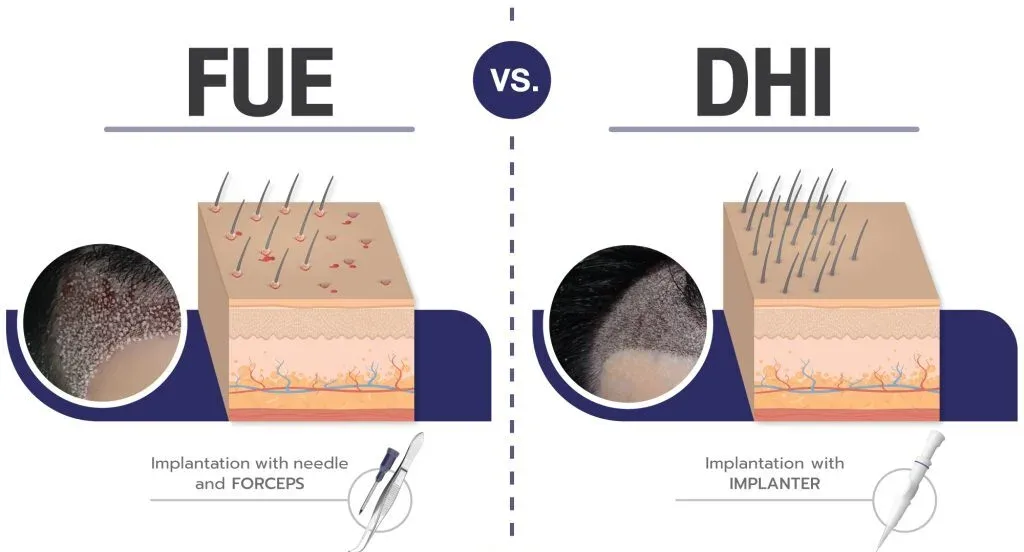
In the FUE technique, no strip is removed; instead, a cylindrical micro-punch (a circular, hollow blade) separates the shortened follicles one by one from their surroundings, and they are transferred into the front channels. The biggest difference is that FUE transplants follicles one at a time, whereas FUT transplants them in groups of two, three or more.
The advantages of FUE
FUE has several advantages over FUT:
- Aesthetic result: in FUT, multiple follicles emerging from one channel can create a "doll's hair" look; in FUE, each hair is placed individually and can be angled, so it looks far more natural.
- Donor area: FUT requires the donor area to be closed with sutures, while in FUE it heals on its own within about 48 hours.
- Scarring: FUT leaves a visible linear scar; FUE thins the donor area slightly but leaves no scar.
- Difficulty: FUT is a coarser, easier technique, whereas FUE takes more skill and time because follicles are removed one by one.