A brief history: from FUT to FUE
Since its arrival in 2002, the Follicular Unit Extraction (FUE) technique has revolutionised hair transplantation, eclipsing the older Follicular Unit Transplantation (FUT) method. Where FUT removed a strip of hair-bearing tissue from the nape and sliced it into smaller units, FUE allows individual hair follicles to be extracted one by one. This progression led to more natural-looking results and increased patient demand.
The limits of current techniques
Although FUE replaced FUT as the gold standard, the technique has seen minimal innovation over the past 15 years. Because it is highly skill-intensive, it has faced challenges in countries relatively new to the practice. Robotics was introduced to overcome these limits, but it remains expensive and less effective than skilled manual transplantation.
Introducing the DHI technique
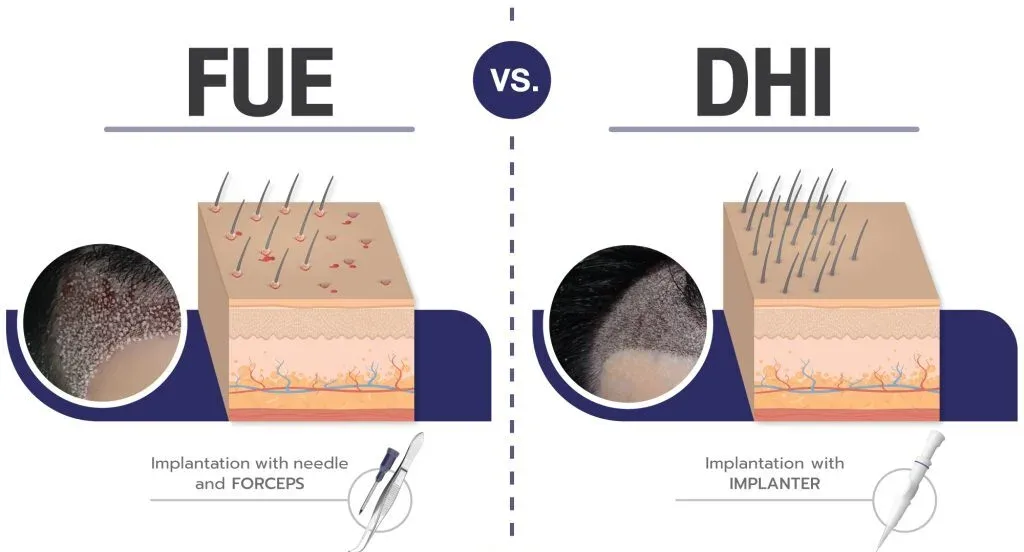
The most notable recent advance is Direct Hair Implantation (DHI). Also known as the pen technique, DHI uses a special implanter pen to place each follicle directly into the scalp. This contrasts with traditional FUE, where slits are manually created in the recipient area first and the follicles inserted afterwards, a two-step process that can sometimes damage follicles and reduce success.
Advantages over traditional methods
The benefits of the DHI technique are many:
- Natural angles: greater precision in setting the angle of each implanted hair, for more natural-looking results.
- Preservation of existing hair: DHI avoids damaging any hairs already present during transplantation.
- Higher density: more hairs can be implanted, producing a denser, fuller look.
- Quicker healing: the small incisions allow faster, more comfortable recovery.
- No shaving required: most significantly, DHI eliminates the need to shave the recipient area beforehand.
In conclusion
Overall, DHI offers an innovative and effective approach to hair restoration. With advantages including the preservation of existing hair and faster healing, it is setting a new standard in the field.