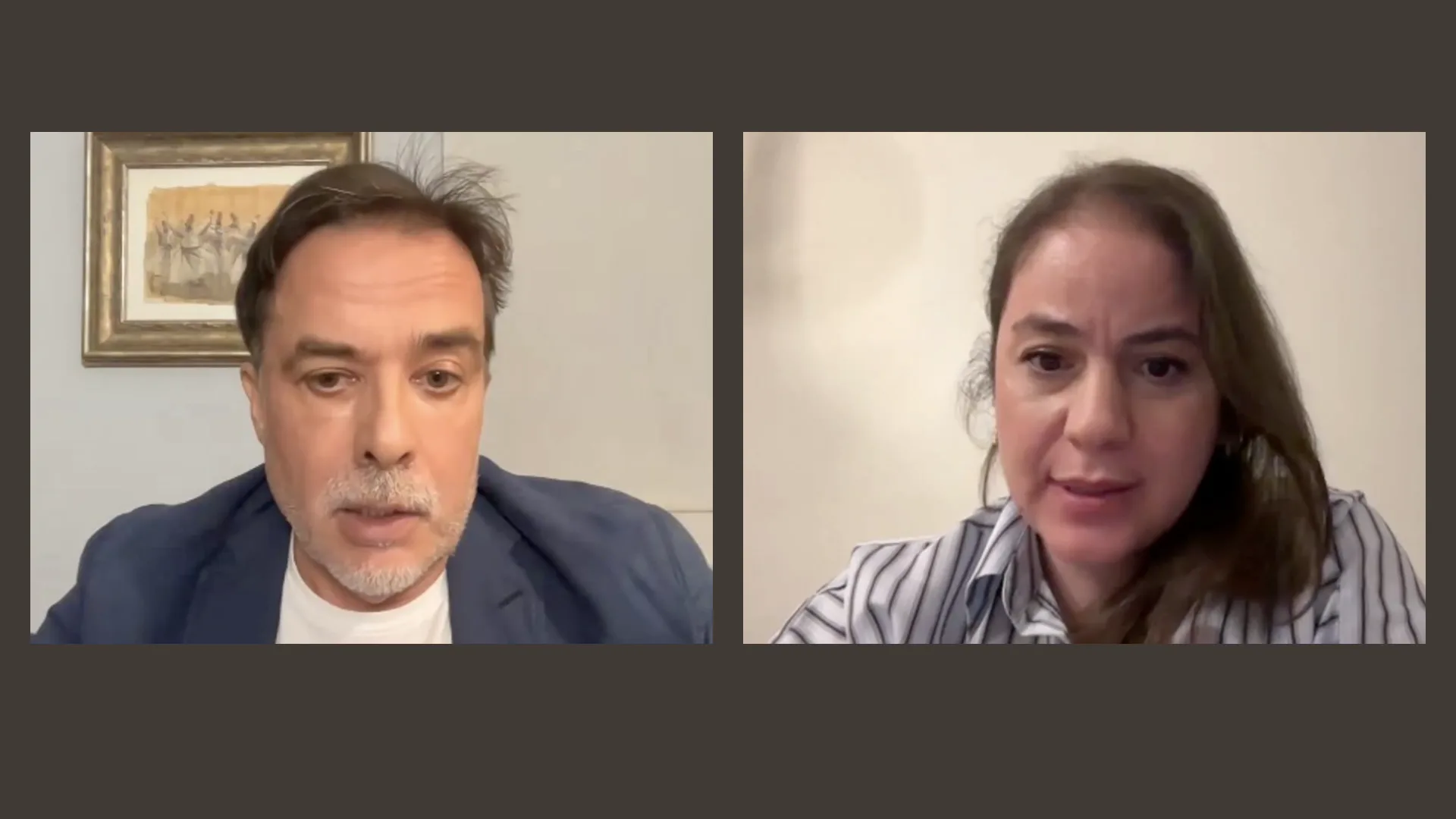
Our first free online lipedema session was held on 18 August, and one fact from it decides more than any other: there is no blood test for lipedema, and no scan that confirms it. Thirty minutes on Zoom, cameras off, questions asked in writing without anyone having to give a name, then a question and answer round that ran well past its slot. This is a summary of what was covered, written for the women who could not attend and for the ones who did and want to read it again slowly.
The session was presented by Prof. Dr. Ferit Demirkan, a plastic, reconstructive and aesthetic surgeon, together with Mine Simsek, the physiotherapist who works with his lipedema patients before and after surgery. He covered the disease and the surgical side. She covered recovery, compression and the parts of the process that happen at home, long after the operating room.
The invitation below is the German-language version of the announcement for this first round. The session itself was held in English with live captions on screen, and the next one will be too.
Lipedema is diagnosed by a doctor, not by a machine
The first point of the session was also the most practical one. There is no blood test for lipedema, and no scan that returns a yes or a no. The diagnosis is clinical: it is made from the patient's history and a physical examination, by a doctor who knows what the condition looks like and, just as importantly, what it does not look like.
That is why so many women spend years without an answer. A body that does not respond to dieting is read as a willpower problem rather than a medical one, and because nothing shows up on a test result, there is nothing to argue with. Prof. Dr. Demirkan's point was that the pattern itself is the evidence: symmetrical fat accumulation that stops at a clear line, tenderness to the touch, bruising that appears from almost nothing, and a heaviness in the legs that has nothing to do with body weight.
Lipedema or lymphedema? Look at the hands and feet
The question that came up most often, both during the presentation and again in the question and answer round, was how to tell lipedema and lymphedema apart. The two are confused constantly, including by clinicians, and the distinction matters because the treatments differ.
The practical answer he gave was to look at the hands and the feet. Lipedema characteristically spares them: the swelling stops above the ankle or the wrist, which is why patients often describe a visible cuff or bracelet effect where the affected tissue ends. Lymphedema does not spare them. It involves the foot and the toes, and it is usually asymmetrical, affecting one limb more than the other, while lipedema is symmetrical by definition.
The two can also exist in the same patient at the same time, which is where it gets complicated: a lipedema left untreated for long enough can bring a lymphedema component with it. That combined picture was a question of its own on the night, and the answer was that surgery is still possible in many of these cases, but it is planned differently and the assessment has to be done in person.
Where the swelling actually comes from
One slide in the presentation did more work than any explanation: healthy tissue next to lipedema tissue, side by side. In lipedema the fat cells enlarge and become irregular, the fascia around them thickens and stiffens, the lymphatic vessels are compressed, and fluid accumulates in between. The result is not simply more fat. It is fat in an inflamed environment.
That inflammatory environment is what produces the symptoms patients actually complain about: the tenderness, the pain on pressure, the easy bruising and the dimpled surface. It is also the reason lipedema behaves differently from ordinary weight gain, and the reason it does not respond the way ordinary weight gain does.
Where liposuction fits, and what it does not do
Liposuction is the first-line treatment for lipedema, and the speakers were careful about what that sentence means. It does not cure the condition. What it does is remove the diseased fat and halt the progression of the disease. It may also correct the disproportion, and in some patients reduce the pain and tenderness that come with it.
The timing argument was the strongest part of this section. Lipedema is staged, and it does not stay where it is. It typically begins in the thighs, sometimes in the upper arms, and moves down to the calves in stage two. Intervening at that stage is what can keep the stage three picture from developing, where skin folds above the knees and ankles start to obstruct lymphatic drainage and a second, larger problem is added to the first. Waiting does not keep the options open; it narrows them.
Calf and ankle liposuction was singled out as its own case. It needs specific techniques, serial bandaging and restricted movement afterwards, and the downtime is longer than most people expect, in the range of three to four weeks.
Diet, movement and the part that stays with you
Surgery removes fat cells that are already there. It does not stop new weight from being gained, and weight gain is what pushes lipedema forward. This was stated as the single most important factor in long-term treatment, before and after any operation.
The recommendation was an anti-inflammatory way of eating rather than a restrictive diet, on the reasoning that the target is the inflammation around the fat cells, not the number on the scale. On exercise, the advice was to combine types rather than pick one: movement that supports the lymphatic system, resistance work to maintain muscle, and low-impact cardiovascular activity, with swimming and water-based exercise mentioned favourably because the water itself provides compression.
After the operation: compression, and what the patient does
This was Mine Simsek's section, and it moved the subject from what a surgeon does to what the patient does. Her point was that the result of lipedema surgery is not decided in the operating room alone. It is decided over the weeks that follow, by how consistently the compression garment is worn and by how the patient moves.
Compression garments were described as the non-negotiable part: correctly fitted, worn for as long as the surgeon specifies, and replaced when they lose their tension rather than worn until they are comfortable. She also recommended wearing compression during exercise, not only at rest, to protect the lymphatic system while moving.
Manual lymphatic drainage, performed by a trained therapist, was recommended. Pneumatic compression machines, the pump devices sold for home use, were not. The caution was specific: used without supervision and without an understanding of the individual patient's lymphatic anatomy, these devices can push fluid in the wrong direction and do harm rather than good. If a device is going to be used at all, it should be on the advice of the treating team.
The questions that came up most
Most of these are answered above, because they are the questions the session was built around. They are worth listing anyway: if you have been carrying one of them on your own, you were not the only person in the room asking it.
- How do I tell whether this is lipedema or lymphedema?
- If I have both, can I still have liposuction?
- What should I be eating, and does a specific diet help?
- What kind of exercise is safe, and how much?
- Are the lymphatic drainage machines sold for home use worth buying?
- Does stress make lipedema worse?
The four things worth remembering
Across very different questions, the speakers kept returning to the same four points.
- Get assessed early. The stage you are in decides how much can be done, and how simply.
- Treat the inflammation, not just the weight.
- Move in more than one way, and wear compression while you do it.
- Be sceptical of any device or protocol that promises to handle lipedema without a clinician looking at you first.
The next session
This was the first of what will become a series. The date of the next one will be announced once it is set, and registration will open with it. If a question was not answered on the night, or one has come up since, you can send it to us at any time and it will reach the team.