In a woman who has lipedema, surgery is not a cosmetic procedure. It is a functional treatment: the aim is not to slim the leg but to reduce pain, make movement easier and lighten the load carried by the tissue. The distinction is not wordplay. It decides how the patient is received, which specialist she is referred to and how her treatment is funded.
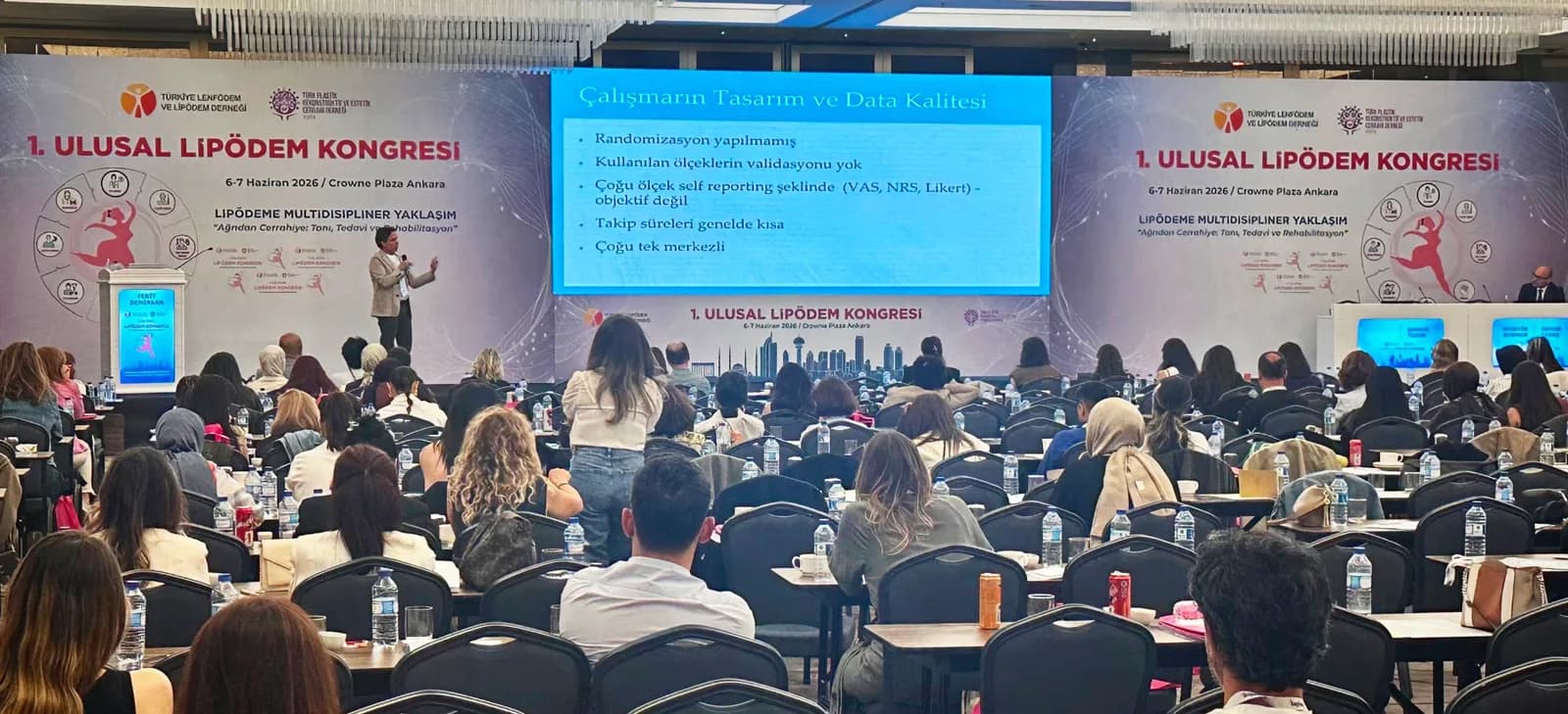
At the 1st National Lipedema Congress, held in Ankara on 6 and 7 June 2026, the title of Prof. Dr. Ferit Demirkan's talk was exactly that question: "Is lipedema surgery cosmetic or functional?" The congress theme was a multidisciplinary approach to lipedema, from pain to surgery.
The widest table of its kind assembled in Turkey so far
The congress was organised by the Turkish Society of Lymphedema and Lipedema together with the Turkish Society of Plastic, Reconstructive and Aesthetic Surgery, chaired by Prof. Dr. Pinar Borman. Physical medicine and rehabilitation specialists, plastic surgeons, cardiovascular surgeons, dermatologists, dietitians and physiotherapists sat in the same room.
That mix is not incidental. Lipedema does not fit inside the boundaries of one specialty: the diagnosis is often made by physical medicine or dermatology, conservative treatment is run by physiotherapy, plastic surgery enters when an operation is indicated, and nutrition continues throughout. The reason so many women spend years moving from one door to the next is precisely this fragmentation.
Why the label has practical consequences
Calling a treatment cosmetic removes it from the list of medical necessities. That reaches the patient in three concrete ways: it falls outside reimbursement, her complaints are taken less seriously, and she spends years hearing that losing weight will fix it.
Yet a woman with lipedema does not present because of how her legs look. The complaints raised most often are pain on touch, easy bruising, a heaviness in the legs that builds through the day, and a walking distance that keeps shrinking. That the rest of the body responds to diet and exercise while the legs do not is itself a sign of the disease, not a sign of weak willpower.
The same instrument does not make it the same operation
Lipedema surgery also uses liposuction, and that is where the confusion begins. But two procedures performed with the same instrument are not the same operation when the indication, the tissue and the goal all differ.
Aesthetic liposuction and lipedema surgery compared
| Aesthetic liposuction | Lipedema surgery | |
|---|---|---|
| Reason for presenting | Dissatisfaction with body contour | Pain, tenderness and restricted movement |
| Goal | A change of shape | Reducing symptoms and preserving function |
| Tissue | Healthy fat tissue | Inflamed and fibrotic tissue |
| Extent | Limited areas | Symmetrical and wide areas, often across more than one session |
| Afterwards | A short recovery | Compression, physiotherapy and long-term follow-up |
| Expectation | A one-off result | Eases the symptoms; does not remove the disease |
The last difference is the critical one. Lipedema surgery does not remove the disease. By reducing part of the affected tissue it eases the symptoms; the need for conservative treatment, compression and a movement routine continues after the operation as it did before.
Where the evidence is weak
The most discussed part of the talk was not about whether surgery helps, but about the methods of the studies claiming that it does. The literature on lipedema surgery is growing in volume and still weak in design.
Each of the five points on the slide has a practical consequence for the patient.
- No randomisation. Because patients who had surgery and patients who did not were not allocated at random, it is hard to separate how much of the improvement came from the operation itself.
- The scales used are not validated. Most studies use measurement tools that have not been validated for lipedema, so results from different studies cannot be compared with each other.
- Most measurements are self-reported. Scales such as VAS, NRS and Likert measure pain as far as the patient reports it. That is valuable, but it is not objective data.
- Follow-up periods are short. In a chronic and progressive disease, results at six months or one year say little about durability.
- Most series come from a single centre. The result of one team reflects that team's experience; it does not produce a general expectation.
Does that mean you should not have surgery?
No. Weak evidence does not mean there is no benefit; it means the size of the benefit has not yet been measured reliably. There is a consistent clinical observation that pain and restricted movement decrease in appropriately selected patients. What is missing are studies that confirm that observation with a sound method.
What it does change is this: an approach that promises the patient precise figures, quotes a definite improvement rate or describes a permanent result in a single session is not supported by this literature. An honest conversation is one that also explains the uncertainty.
Questions worth asking before deciding
For someone considering lipedema surgery, these are the practical headings that came out of the discussion at the congress.
- Was the diagnosis made by clinical examination, or only by looking at the appearance?
- Was a lymphedema component assessed? The two can coexist, and that changes the plan.
- Was conservative treatment tried, and what was the outcome?
- How many sessions are planned, and which areas are targeted?
- Who will run the compression and physiotherapy programme after surgery?
- Which symptom is expected to improve and by how much, and which symptom is likely to remain?
The last question is the most telling. A plan that can also say what will not improve is more trustworthy than one that only describes what will.