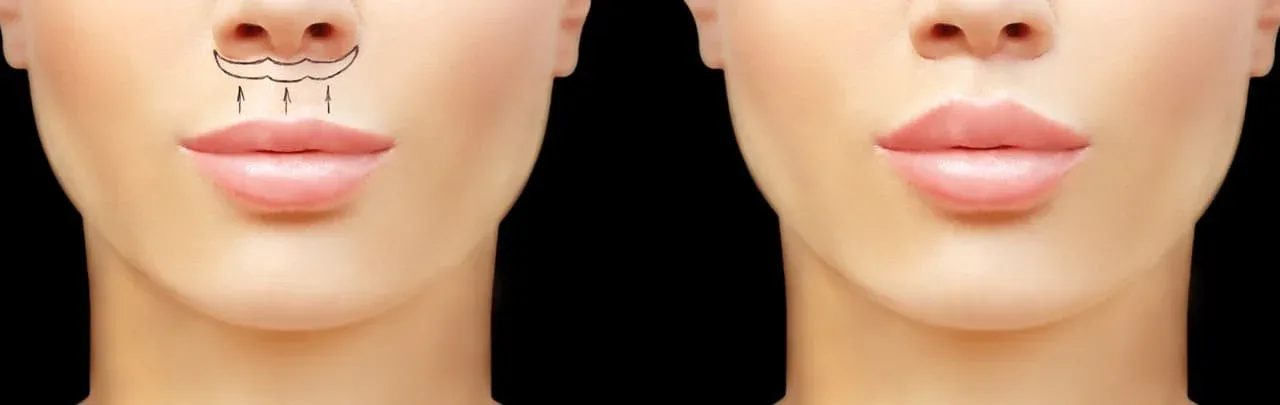
New-generation hyaluronic acid fillers make natural, fuller lips possible. After the eyes, the lips are the most defining feature of an attractive face. Digital facial studies in women have shown that increasing the lip area by about 50% raises the attractiveness of the face, and similar studies found that greater redness contrast on the face increases perceived appeal. So could a lip filler be the shortest path to a more attractive look? It can, provided you do not overdo it and stay close to natural.
Two lips can both be full yet differ in structure. A lip that is larger and redder can still look less attractive if its form and colour appear artificial. That is why lip augmentation must respect certain anatomical proportions. Ideally, if the upper lip height is 1 unit, the lower should be about 1.6 units (the golden ratio). An upper lip equal to or larger than the lower almost always looks off-putting.
How a lip filler is planned
To assess the lip, we divide it vertically into three and then each lip horizontally into three, for a total of 18 zones; the contour lines form the outermost horizontal sections. Viewed from the front, we first decide which part of each lip needs volume, all zones equally, only the centre, or more towards the sides, and adjust the amount injected per zone to achieve the desired effect. Each lip is then examined from the side: the most projecting (the pout) should fall in the second zone. If the contour line is already forward, no filler is placed there. In general, the upper lip should sit slightly ahead of the lower.
How it is performed
An anaesthetic cream is applied and left for about 20 minutes. The best way to deliver lip filler is with cannulas, thin, long metal rods with blunt tips, so the risk of bleeding and bruising afterwards is very low and, being long, they allow single-pass applications.
Because the cannula tip is not sharp, it cannot pierce the skin directly: a small entry hole is first made with a needle of similar thickness, then the cannula is inserted and advanced under the skin in the desired direction. Some catching or tugging sensations may be felt, but it is far less painful than needle-based techniques. Most lip fillers also contain anaesthetic agents, so numbness begins almost immediately.
When are results seen, and how long do they last?
Results are immediate, but the lips are very sensitive to any manipulation and begin to swell during the procedure itself. Add the water that the hyaluronic acid in the filler attracts, and your lips may look larger than expected for the first few days. Massage started the next day reduces the swelling and refines the shape.
Because the lips are highly mobile, fillers there last less than in other areas, and everyone's level of the hyaluronidase enzyme that dissolves hyaluronic acid differs. The average duration is around 10 months, varying between 8 and 14 months.
Types of filler used
Three densities of hyaluronic acid filler can be used in the lips:
- Denser fillers for shaped lips: these make lips look firmer but can be felt when touched.
- Medium-density fillers for full lips: these give soft, fleshy lips that are not detectable by touch.
- Low-density fillers for the lip contour and fine lines around the lips: these act more like a moisturiser.
Hyaluronic acid lip fillers do not affect speech or kissing, and do not create numbness or stiffness. They are less risky than other lip-enhancement methods. Permanent fillers in the lip increase the risk of allergic reaction; because such material is fluid, it is impossible to fully remove if a reaction occurs, it is evacuated as much as possible and suppressive treatment is applied.